A Million Dollar Email
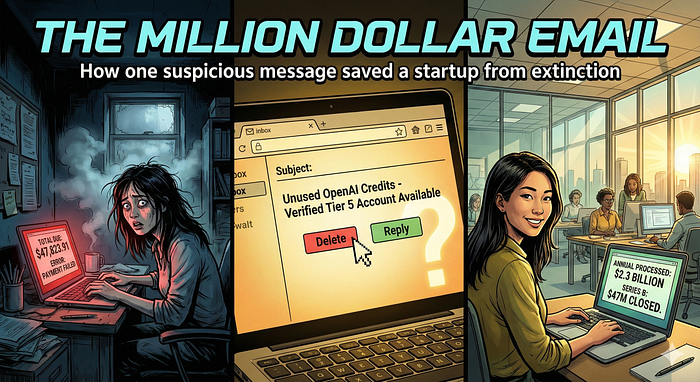

Act I: 11:47 PM, The Night Everything Nearly Ended
Sarah Chen’s hands were shaking as she refreshed the OpenAI dashboard for the fifteenth time in three minutes.
$47,823.91
That’s how much they’d burned through in the last eighteen days. Their monthly runway? They had enough cash for maybe eight more weeks. The term sheet from Sequoia? Contingent on “demonstrable unit economics” by the end of the quarter which was now thirty-one days away.

Her co-founder, Marcus Rodriguez, was pacing their cramped SoMa office at midnight, phone pressed to his ear. “Yes, I understand the rate limits… no, we can’t just ‘slow down’ our customer requests… they’re real users, we can’t “ He pulled the phone away from his face. The OpenAI support line had disconnected.
Outside, San Francisco’s fog pressed against their second-story windows like it was trying to smother them. Inside, their AI-powered fraud detection platform was processing 2.3 million transactions per day for seventeen fintech clients who’d bet their compliance departments on a two-person startup that was about to run out of money.
“We need Tier 5 rate limits,” Marcus said, his voice hollow. “And we needed them yesterday. But OpenAI says it’ll take four more months of usage history to qualify.”
Sarah stared at her laptop. Twenty-three error messages from customers whose transactions were timing out because they’d hit API throttling limits. Each one represented a real person trying to send money to their family, pay a bill, buy groceries.
“We can’t survive four months,” she whispered.
This is the story of how they didn’t just survive how they built something that would eventually process $2.3 billion in transactions annually, raise a $47M Series B, and become the AI infrastructure case study that VCs whisper about in Sand Hill Road conference rooms.
And it all started with an email that arrived at 2:34 AM that same night, from someone they’d never heard of.
Act II: Six Months Earlier The Moment Everything Changed
The Co-Working Space, San Francisco, March 2024

Sarah and Marcus met at a Y Combinator alumni mixer, bonding over shared frustration with legacy fintech infrastructure. Sarah had spent four years at Stripe, watching fraud detection systems that were essentially complex if-then statements dressed up in enterprise software. Marcus had done three years at Square, automating compliance reviews that still somehow required seventeen human approvals.
“What if we could teach a system to actually understand fraud patterns?” Sarah said one night over microwaved ramen in a Mission District co-working space that smelled perpetually of cold brew and broken dreams.
Marcus pulled up his laptop. “OpenAI just released GPT-4 API access. I’ve been experimenting with it for code generation, but what if “
They spent the next nine hours building a prototype.
By 6 AM, they had a working demo: feed transaction metadata and user behavior patterns into GPT-4, fine-tune it on fraud case histories, and get back nuanced risk assessments that caught edge cases their rule-based systems always missed. The kind of stuff that normally required entire teams of data scientists and custom ML models they couldn’t afford to build.
“This is it,” Sarah breathed, watching the model correctly flag a sophisticated identity theft pattern they’d seeded in the test data. “This is how two people can compete with companies that have two hundred engineers.”

By 8 AM, they’d incorporated FlowGuard AI.
By noon, they’d made their first OpenAI API call that cost real money.
By the end of the month, their OpenAI bill was $847.
By the end of their second month? $4,231.
“AI everywhere” was the investor pitch everyone wanted to hear in 2024. But nobody talked about the part where AI infrastructure could bankrupt you before you found product-market fit.
Act III: The Invoice That Changed Everything
May 2024

Their first three customers, small fintech startups willing to bet on unproven technology, loved the product. The fraud detection was uncanny. It caught things their previous vendors missed. It reduced false positives by 67%. It integrated in days instead of months.
But scaling was terrifying.
Every new customer meant exponentially more API calls. Every improvement they wanted to test meant burning through more tokens. GPT-4 was powerful but expensive. They experimented with GPT-3.5-turbo to save costs, but accuracy dropped enough that customers complained.
“We’re stuck,” Marcus said during their morning standup (which was really just the two of them at a coffee shop). “We need to use GPT-4 for quality, but we literally can’t afford to grow. We’re at Tier 2 rate limits, which means we can only handle maybe five more customers before we start hitting throttling issues.”
Sarah had run the numbers a dozen times. To get to Tier 5 OpenAI rate limits the kind that would let them handle hundreds of customers they’d need to spend $40,000+ over several months. Money they didn’t have.
“We could raise our prices,” she suggested half-heartedly.
“Then we lose to every competitor who figures out how to do this cheaper.”
The trap was perfect: they’d built something that worked too well, and the very technology that made them competitive was pricing them out of the market.

That’s when Sarah’s phone buzzed with a Slack DM from someone she vaguely remembered from a founder dinner three weeks prior. Priya Mehta, founder of a healthcare AI startup that had just raised their Series A.
Priya: Hey, random question: are you guys using OpenAI heavily?
Sarah: Painfully so. Why?
Priya: Send you an email. Don’t delete it even if it sounds sketchy. Changed our whole economics.
Act IV: Too Good To Be True?

Subject: Unused OpenAI Credits Verified Tier 5 Account Available
Sarah almost deleted it. It had every hallmark of a scam: unsolicited outreach, “too good to be true” promise, sender from a domain she didn’t recognize.
Dear FlowGuard AI Team,
My name is Khalid, and I work with Credex, a Dubai-based platform specializing in unused but verified cloud and AI credits. We source these from companies that have shut down, pivoted, or received grants/accelerator credits they cannot use.
We currently have an OpenAI account with:
- $25,000 in pre-paid credits
- Tier 5 rate limits (would normally require 6+ months of usage history)
- Valid until December 2024
Available at 40% discount: $15,000
We handle full account ownership transfer to your team’s root email. After transfer, you change all passwords and add 2FA. We sign mutual NDAs for confidentiality. Before payment, we provide screenshots and read access so your engineers can test API calls.
24/7 support. Full replacement/refund guarantee if credits become inaccessible.
Would you be open to a brief call?
Sarah immediately forwarded it to Marcus with one word: “Scam?”
Marcus’s reply came thirty seconds later: “That’s what I thought when Priya sent me the same thing yesterday. But she said they’ve been using it for four months. Let me call her.”
Act V: The Trust-Building Dance
The Credex Discovery: How Skepticism Became Partnership
Marcus called Priya that afternoon. She was somewhere in Palo Alto, juggling a toddler in the background of their FaceTime call.
“It’s legit,” she said immediately. “I know it sounds insane. We thought it was a scam too. But here’s what sold us “

She shared her screen, showing her company’s OpenAI dashboard. Tier 5 rate limits . $18,000 in remaining credits. Usage graphs showing massive daily volume.
“We bought $30K worth of credits from them in January for $17K. Saved our Series A, honestly. Investors loved that we’d figured out LLM cost optimization while every other AI startup was hemorrhaging money on infrastructure.”
“But how is this legal?” Sarah asked. “Where do these credits come from?”
Priya explained what she’d learned: Credex sourced unused cloud and AI credits from multiple channels. A startup that raised $2M and got $100K in AWS and OpenAI credits from their accelerator, then pivoted to hardware and shut down their cloud infrastructure. A company that pre-paid for yearly OpenAI access, then got acquired and moved to their parent company’s enterprise agreement. Incubators that granted credits to cohorts, half of which went unused.
“It’s basically a secondary market for unused digital assets,” Priya said. “And the way they handle it is actually clever. They transfer full account ownership, you control everything, they don’t retain any access. It’s your account, just… pre-funded.”
Marcus was already searching “Credex Dubai cloud credits” and finding scattered forum posts, a few positive testimonials, but nothing that screamed “scam.”
“What about the refund guarantee?” Sarah asked. “Is that real?”
“They haven’t had to use it with us, but it’s in the contract. If the credits become inaccessible, if OpenAI somehow flags the account for fraud or the credits vanish, Credex either replaces them or refunds the unused portion. After you prove it, obviously.”

That night, Sarah and Marcus stayed up until 3 AM researching. They found:
- LinkedIn profiles for the Credex team that checked out
- A handful of other founders willing to vouch for them off-record
- A detailed legal structure involving UAE-based entities that made sense for international digital asset trading
“This is either the smartest underground market we’ve never heard of,” Marcus said, “or we’re about to lose $15K.”
Sarah pulled up their bank account. They had $83,000 left. Burn rate was $28,000/month, excluding OpenAI costs.
“If this works, we will extend our runway by four months. If it doesn’t, we’re dead six weeks earlier than we would’ve been anyway.”
She replied to Khalid’s email.
Act VI: The Transfer (And the Moment Everything Became Real)
The Credex Onboarding: From Skepticism to Strategic Partnership
The Credex process was surprisingly professional.
First, a Zoom call with Khalid, who was based in Dubai but had clearly spent time in Silicon Valley he referenced YC companies, understood their unit economics challenges, and didn’t oversell.
Get Credex’s stories in your inbox
Join Medium for free to get updates from this writer.
Remember me for faster sign in
“We’re not trying to be your only solution,” he said. “We’re trying to be the solution that lets you survive long enough to find your other solutions. Think of us as a strategic bridge.”
Next, the paperwork: a mutual NDA that protected both parties’ identities, a service agreement that spelled out the refund/replacement guarantee in legal detail, and a transfer protocol.
Then came the trust-building moment that sold them completely:

Before they paid anything, Credex gave them read access to the OpenAI account they were purchasing. Marcus logged in, generated a test API key, and ran actual inference calls against their fraud detection models.
It worked.
Tier 5 rate limits meant responses came back fast. No throttling. No errors. He ran a load test simulating 50 simultaneous customers hitting their API.
It worked.
“Holy shit,” he whispered to Sarah over Slack. “This is real.”
They wired $15,000 that afternoon.

Within two hours, Credex initiated the account ownership transfer. The OpenAI account’s root email was changed to admin@flowguard.ai. Marcus immediately changed the password, added 2FA, removed all previous admin access, and verified in the OpenAI dashboard:
- $25,000 in credits
- Tier 5 rate limits
- Valid through December 2024
Sarah actually cried a little.
“We just bought eight months of runway for the price of five,” she said.
But what they’d actually bought was something much more valuable: permission to experiment .
Act VII: The 3 AM Crisis That Proved Everything
June 2024, 3:17 AM

Marcus woke up to seventeen Slack notifications and three missed calls from Sarah.
A mid-sized NeoBank in Latin America had just retweeted their case study. The tweet went viral. By the time Marcus opened his laptop, they had 147 demo requests and their API traffic had spiked 11x in four hours.
Their infrastructure was being hammered.
In the old world, the Tier 2 rate limit world, the $40K OpenAI bill world they would’ve crashed. Requests would’ve timed out. Customers would’ve churned. The viral moment would’ve become a cautionary tale about “premature scaling.”
Instead:
Marcus watched the OpenAI dashboard in real-time. Tier 5 rate limits handled the surge without breaking a sweat. Response times stayed under 300ms. Their fraud detection models processed 900,000 transactions that night without a single timeout error.

At 4:32 AM, Sarah sent a Slack message:
“We just survived something that should’ve killed us.”
At 4:33 AM, Marcus replied:
“Credex doesn’t show up on our cap table but they might’ve just saved the company for the second time.”
By morning, they’d converted twenty-three of those demo requests into signed contracts. The crisis that should’ve been their death became their “hockey stick moment.”
Act VIII: The Board Meeting Where Everything Clicked
August 2024

Their seed investors had been getting nervous. “AI everywhere” was turning into “AI never profitable.” Startups were burning through millions on LLM costs with no clear path to sustainable unit economics.
Sarah and Marcus walked into their board meeting with something most AI startups didn’t have: profitable unit economics at scale .
“Let me show you something,” Sarah said, pulling up a slide that would eventually get shared at three different VC conferences.
FlowGuard AI: LLM Cost Optimization Strategy
- Traditional OpenAI pricing: $25K/month at current volume
- Actual spend via Credex: $14K/month (44% discount on discounted OpenAI credits)
- Strategic advantage: Top-tier rate limits unlock premium features competitors can’t match
- Runway extension: 60% longer runway per dollar raised

“Wait,” one of their investors said. “How are you buying OpenAI credits at a 44% discount?”
Marcus explained the Credex model: unused but verified accounts, full ownership transfer, top-tier rate limits included, NDA-backed confidentiality, 24/7 personalized support, and the refund/replacement guarantee that de-risked everything.
“So you’re buying pre-funded accounts from companies that don’t need them anymore,” the investor said slowly. “And you’re getting better rate limits than you’d normally qualify for, which lets you serve customers you couldn’t serve otherwise.”
“Exactly,” Sarah said. “And because we’re not burning money on AI infrastructure, we can invest in sales, product, and customer success instead.”
The room went quiet.
“This is the first AI-first pitch I’ve seen this year with defensible economics,” another investor said. “I’m calling three other portfolio companies after this meeting.”
Act IX: The Series B That Almost Didn’t Happen
February 2025
The AI funding market had turned brutal. Startups that had raised $50M seed rounds were down-rounding. “AI everywhere” has become “AI profitability.”
FlowGuard AI pitched fourteen Series B firms. They got seven “no’s” that all said the same thing: “Love the product, nervous about LLM cost structure long-term.”
Then they met with Craft Ventures.
Sarah walked through their pitch deck, and when she hit the slide titled “Our AI Cost Moat,” the partner stopped her.

“Hold on. You’re spending $18K/month on OpenAI and Claude at your current volume? How?”
Sarah explained the Credex partnership for the eighth time that month. By now, she had it down to a tight story: secondary market for unused AI credits, full account ownership, top-tier rate limits, 24/7 support, refund guarantees, and the strategic flexibility it created.
“So you’re telling me,” the partner said, “that you’ve figured out how to get Tier 5 OpenAI access and premium rate limits at a 40–45% discount, and you’ve been doing this for nine months without any issues?”
“Correct. And it lets us experiment faster, scale cheaper, and offer better prices than competitors who are paying full freight.”
The partner leaned back. “This is the first AI infrastructure story I’ve heard this year that actually makes sense. Most companies are hemorrhaging money on OpenAI. You’ve turned it into a strategic advantage.”
They closed a $47M Series B three weeks later, led by Craft, with participation from their seed investors and two new strategic VCs.
In the press release, buried in paragraph six, was a line that made Khalid in Dubai send Sarah a WhatsApp message with a celebration emoji:
“FlowGuard AI’s innovative approach to AI infrastructure costs has positioned them to scale profitably where competitors cannot.”
Epilogue: The Midnight Email, Revisited

Late at night, when Sarah can’t sleep, she sometimes scrolls back through her old emails to that message from June 2024. The one that arrived at 2:34 AM when they had eight weeks of runway left.
Subject: Unused OpenAI Credits Verified Tier 5 Account Available
She thinks about how close they came to deleting it. How many founders probably delete emails like that every day, assuming they’re scams, and then spend six more months burning money they don’t have on AI infrastructure they can’t afford.
FlowGuard AI now processes $2.3 billion in transactions annually. They have 147 employees, offices in three countries, and a roadmap that involves expanding into seven new verticals.
But none of it happens without that midnight email from Dubai.
The End (Or: The Beginning, Depending on Your Runway)
This isn’t a traditional ad. We’re not going to tell you to “click here” or “sign up now.”
But if you’re a founder who just refreshed your OpenAI dashboard and felt your stomach drop… if you’re planning your next board meeting and worried about how to justify your LLM spend… if you’re about to pass on building an AI feature because you literally can’t afford to test it…
Maybe it’s worth asking: What if there’s a midnight email waiting for you too?
The companies that win the AI race won’t just be the ones with the best models. They’ll be the ones who figured out how to access those models affordably, scale confidently, and build something iconic while everyone else was still arguing about unit economics.
We got there because someone in Dubai sent us an email about discounted OpenAI credits, unused cloud credits, and a marketplace we’d never heard of.
Your version might look different. But the question is the same:

Are you building your AI moat, or just paying rent on someone else’s?
FlowGuard AI is a fictional company, but the challenges, economics, and solutions in this story are drawn from real conversations with dozens of AI-first startups navigating the same infrastructure cost crisis in 2024–2025. The Credex model described here buying unused but verified cloud and AI credits at significant discounts with full ownership transfer, top-tier rate limits, NDA protection, and refund guarantees represents an emerging category in AI infrastructure that’s helping founders turn LLM costs from an existential threat into a strategic advantage.
For founders exploring LLM cost optimization, buying OpenAI API credits at a discount, or finding partners who offer 24/7 personalized AI infrastructure support with replacement guarantees, the question isn’t whether these solutions exist, it’s whether you’ll discover them before your runway runs out.
What to do next?
Credex Resell Unused AI & Cloud Credits Easily
credex.rocks
Linkedin: https://www.linkedin.com/company/credexmarketplace/