How to Build Voice AI Without Burning Through Your Budget: $500K in Deepgram Credits at 50% Off
The Voice AI Revolution Is Here But Are You Ready for the API Bills?
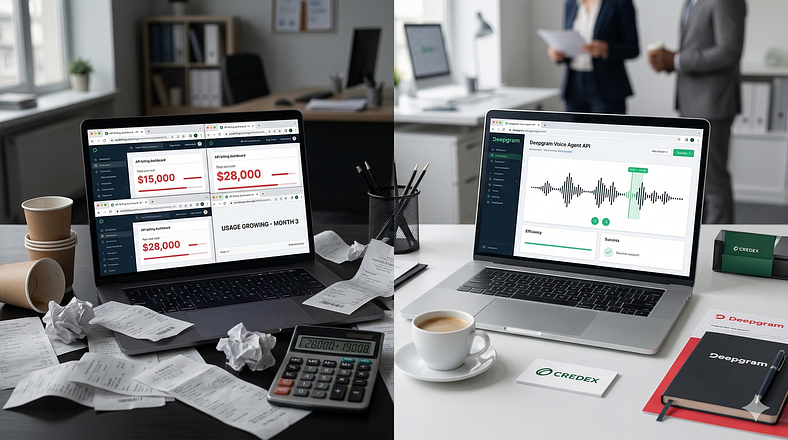
The Voice AI Cost Crisis Nobody Talks About
Your product roadmap looks perfect. Voice-enabled customer support. AI-powered call analytics. Real-time transcription for your SaaS platform. Conversational voice agents that actually work.
The demos are impressive. Your team is excited. Leadership is bought in. You’ve secured budget and engineering resources.
Then you start processing real production volume, and the API bills hit.

Month 1 : $8,000 in speech-to-text costs Month 2 : $15,000 as usage grows Month 3 : $28,000 and climbing
Your CFO asks: “Why is our voice AI infrastructure costing more than our entire cloud bill?”
You don’t have a good answer. Because the truth is uncomfortable: voice AI at scale is brutally expensive when you’re paying full price.
This isn’t a problem with your product. It’s not poor planning. It’s the reality of modern voice AI infrastructure transcription APIs, text-to-speech services, voice agent platforms all charging premium rates while your product is still finding product-market fit.
The Real Numbers Behind Voice AI Costs

Let’s break down what building voice AI actually costs at production scale.
Customer Support Voice Agent (Medium-sized company):
- 50,000 customer calls per month
- Average call duration: 8 minutes
- Total processing: 400,000 minutes/month
- Standard STT pricing: ~$0.006/minute
- Monthly cost: $2,400 (just for transcription, not including LLM or TTS)
Call Center Analytics Platform:
- 200 agents × 6 hours/day × 22 working days
- Total: 1,584,000 minutes/month
- Add sentiment analysis, topic detection, summarization
- Standard pricing with intelligence features: ~$0.012/minute
- Monthly cost: $19,008
Real-time Captioning Service:
- 10,000 hours of live streaming/month (600,000 minutes)
- Real-time processing with low latency requirements
- Premium tier pricing: ~$0.008/minute
- Monthly cost: $4,800
Healthcare Documentation AI:
- 5,000 patient consultations/month
- Average session: 25 minutes
- HIPAA-compliant processing required
- 125,000 minutes/month at ~$0.010/minute
- Monthly cost: $1,250
These aren’t edge cases. These are typical production workloads for companies building voice-first products.
And here’s what makes it worse: you can’t just choose a cheaper provider and call it done.
The Accuracy-Cost-Latency Triangle: Pick Two (Maybe)
Voice AI has a fundamental constraint that GPU compute doesn’t: real-time performance requirements.
When training a foundation model, you can wait 10 days for results. But when a customer is having a conversation with your voice agent, every 100ms of latency destroys the experience.
This creates an impossible optimization problem:

High Accuracy + Low Latency = Expensive Premium providers charge premium prices for models that work well in real-time.
Low Cost + High Accuracy = Slow Cheaper batch processing might be accurate but kills conversational AI use cases.
Low Cost + Low Latency = Poor Quality Fast and cheap means embarrassing transcription errors that damage your brand.
Most companies building voice AI end up choosing “expensive but good” because the alternative is shipping a bad product. But that choice is killing their unit economics.
Why Traditional Cost-Cutting Doesn’t Work
You’ve probably already tried the obvious solutions:
“Let’s negotiate volume pricing” — Most providers offer 10–15% discounts at high volume. That helps, but doesn’t solve the fundamental economics problem.
“Let’s use a cheaper provider” — You test alternatives. The accuracy is noticeably worse. Customer complaints spike. You switch back to the expensive option.
“Let’s batch process instead of real-time” — This works for some use cases (media transcription, post-call analytics) but kills the conversational AI experiences customers actually want.
“Let’s limit features to reduce API calls” — Now you’re designing your product around cost constraints instead of user needs. Your competitors with better-funded infrastructure pull ahead.
The reality is: if you’re building serious voice AI products, you need enterprise-grade infrastructure. And at full price, that’s unsustainable for most companies.
The Competitive Disadvantage Compounds
While you’re trying to optimize costs and make trade-offs, here’s what’s happening:
Competitor A secured enterprise pricing through an investor relationship. They’re processing 3x your volume at lower per-unit costs because they have scale discounts you can’t access yet.
Competitor B raised a larger round and can subsidize voice features while capturing market share. They’re not profitable, but they’re growing faster.
Competitor C built their own speech models. It took them 18 months and $2M in ML talent, but now their marginal costs are near zero.
You’re stuck in the middle paying full retail price for infrastructure, watching competitors with cost advantages move faster.
This is the voice AI infrastructure trap. And it’s stalling product roadmaps across the industry.
There’s a Smarter Path to Voice AI Infrastructure
This is where Credex changes the economics of building voice-powered products.

We provide $500K in Deepgram credits with 1-year validity at 50% off standard pricing . Not a volume discount that requires hitting a massive scale first. Not a promotional credit that expires in 90 days. Verified, fully-transferable Deepgram credits at half price.
You get legitimate Deepgram credits with:
- 50% discount off standard Deepgram pricing
- Immediate access to enterprise-grade voice AI infrastructure
- 1-year validity for long-term product development
- Full account ownership with complete control
The infrastructure problem isn’t unsolvable. You just need a different path to capacity.

Why Deepgram for Voice AI Infrastructure
Before we talk about savings, let’s establish why Deepgram matters for serious voice AI products.
Deepgram isn’t a generic transcription API. It’s a purpose-built voice AI platform designed for developers building products where accuracy, latency, and cost all matter.

Nova-3: Industry-Leading Accuracy
Nova-3 delivers a 5.26% word error rate (WER) on standard benchmarks, making it one of the most accurate speech recognition models available. For context, this represents 54.2% better accuracy than competitors like Whisper and Google Chirp 2.
Why this matters: Every 1% improvement in WER means fewer customer support escalations, better voice agent experiences, and more accurate call analytics. Poor transcription accuracy isn’t just annoying, it’s a product liability.

Sub-300ms Latency: Enabling Real Conversations
Deepgram’s streaming transcription typically delivers results in under 300 milliseconds, with many use cases achieving sub-200ms latency.
Why this matters: Human conversation requires turn-taking. If your voice agent takes 800ms to recognize speech ends and another 500ms to respond, the conversation feels broken. Deepgram’s latency enables natural conversations where AI can interrupt, respond quickly, and handle real-time interactions.
Flux: Conversational AI-Native Model
Flux is Deepgram’s first conversational speech-to-text model with built-in turn detection. Unlike traditional transcription models trained on clean audio, Flux understands overlapping speech, interruptions, and the messy reality of human conversations.
Use cases unlocked: Voice agents that can interrupt when appropriate, real-time meeting transcription with speaker attribution, customer support analytics that understand conversational dynamics.
Voice Agent API: The Full Stack
Deepgram’s Voice Agent API combines speech-to-text, LLM integration, and text-to-speech in a single unified interface. Instead of stitching together three separate APIs with their own latency overhead, you get a purpose-built stack for conversational AI.
Why this matters: Reducing API hops from 3 to 1 saves 100–200ms of latency per turn. For a 5-minute conversation with 20 exchanges, that’s 2–4 seconds of smoother experience.
Per-Second Billing (Not Rounded Minutes)
Deepgram bills per second rather than rounding up to full minutes like AWS Transcribe. For workloads with many short audio segments, this creates significant cost advantages.
Real example: Processing 10,000 voice commands averaging 8 seconds each:
- AWS rounds each to 1 minute: 10,000 minutes billed
- Deepgram bills actual usage: 1,333 minutes billed
- You save 87% on this workload
45+ Languages with Consistent Quality
Deepgram supports over 45 languages, all with the same accuracy and latency characteristics. You’re not switching to an inferior model for non-English markets.
Get Credex’s stories in your inbox
Join Medium for free to get updates from this writer.
Remember me for faster sign in
Why this matters: If you’re building a global product, you can’t have great English transcription and terrible Spanish accuracy. Deepgram gives you consistent quality across markets.
Real-World Use Cases Deepgram Powers
Voice Agents & Conversational AI: Companies building customer service automation, virtual assistants, and voice-first interfaces rely on Deepgram’s low latency and conversational models.
Call Center Analytics: Deepgram’s Audio Intelligence features like sentiment analysis, topic detection, and summarization help companies extract insights from millions of customer calls.
Healthcare Documentation: HIPAA-compliant deployment options make Deepgram suitable for medical dictation and patient consultation transcription.
Media & Content: Podcast platforms, video hosting services, and content creators use Deepgram for batch transcription, captioning, and searchable audio archives.
Live Captioning: Streaming platforms, virtual events, and accessibility tools leverage Deepgram’s real-time processing for live transcription with minimal delay.

The Credex Advantage: Enterprise Voice AI at Startup Economics
Here’s what separates Credex from trying to buy Deepgram credits directly:
Immediate 50% Cost Reduction
$500K in Credex Deepgram credits = $1M worth of standard Deepgram capacity .
Real-world cost comparison:
Customer Support Voice Agent (50,000 calls/month, 8 min avg):
- 400,000 minutes/month
- Standard Deepgram: ~$0.006/min = $2,400/month
- Credex Deepgram: ~$0.003/min = $1,200/month
- Savings: $1,200/month ($14,400 annually)
Call Center Analytics (200 agents, full-time):
- 1,584,000 minutes/month with Audio Intelligence
- Standard: ~$0.012/min = $19,008/month
- Credex: ~$0.006/min = $9,504/month
- Savings: $9,504/month ($114,048 annually)
Real-time Captioning Service (10,000 hours/month):
- 600,000 minutes/month
- Standard: ~$0.008/min = $4,800/month
- Credex: ~$0.004/min = $2,400/month
- Savings: $2,400/month ($28,800 annually)
Healthcare Documentation (5,000 consultations/month):
- 125,000 minutes/month
- Standard: ~$0.010/min = $1,250/month
- Credex: ~$0.005/min = $625/month
- Savings: $625/month ($7,500 annually)

With $500K in credits at 50% discount, you’re getting processing capacity that would cost $1M at standard rates. For most voice AI companies, that’s 12–24 months of production infrastructure.
1-Year Validity: Strategic Planning Freedom
Voice AI product development isn’t a sprint. Building conversational experiences, training custom models, and achieving product-market fit takes time.
With 1-year credit validity, you can:
- Plan multi-phase rollouts without rushing to use credits before expiration
- Experiment aggressively knowing you have budget for failed experiments
- Scale predictably without worrying about surprise bills during growth phases
- Budget accurately across quarters with fixed infrastructure costs
Better Unit Economics Enable Better Products
Here’s what 50% cost reduction actually means for your product strategy:
You can afford higher quality: Choose Deepgram’s most accurate models without compromise. Don’t trade accuracy for cost.
You can ship more features: That voice-activated search you postponed because of API costs? Now it’s viable.
You can serve more markets: Expand to Spanish, French, and German markets without tripling your infrastructure bill.
You can iterate faster: Run A/B tests on conversation flow, try different voice personas, experiment with features all without budget anxiety.
Lower costs per transaction improve unit economics. Better unit economics means you can grow sustainably instead of burning cash on infrastructure.

Full Ownership & Enterprise Support
These aren’t shared credits or resold access. You receive:
- Full Deepgram account ownership with complete administrative control
- Verified credit transfer recognized by Deepgram
- 24/7 Credex support for account setup and optimization
- Usage analytics to track credit consumption and optimize spend
- NDA protection for your voice AI strategies and product roadmap

What $500K in Deepgram Credits Enables
For Voice AI Startups:
- 12–18 months of production infrastructure for early-stage products
- Aggressive experimentation without burning runway on API costs
- Ability to offer voice features competitively priced vs. competitors
For Enterprise Teams:
- Department-wide voice AI initiatives (customer support, sales enablement, internal tools)
- Multi-language expansion without infrastructure budget battles
- Proof-of-concept budgets that don’t require VP approval for every test
For Product Teams:
- Ship voice-first features without waiting for finance approval
- A/B test conversational flows with real production traffic
- Build voice into your product roadmap as a standard capability, not a luxury
The Competitive Advantage
While your competitors are either:
- Paying full price and burning budget
- Using cheaper alternatives and shipping inferior experiences
- Limiting voice features to control costs
You’re building with enterprise-grade infrastructure at half the cost.
That advantage compounds:
- You can price more aggressively and still maintain margins
- You can invest saved infrastructure budget into product, marketing, or hiring
- You can experiment more, which means you’ll find product-market fit faster
- You can expand to new use cases and markets without budget constraints
In markets where product velocity determines category winners, infrastructure cost advantages matter enormously.
Stop Paying Full Price for Voice AI Infrastructure

The voice AI market is moving fast. Conversational interfaces are becoming table stakes. Companies that nail the experience early will capture markets.
But you can’t build great voice products while constantly worrying about API bills or making quality trade-offs to hit budget targets.
$500K in Deepgram credits through Credex gives you:
50% savings vs standard Deepgram pricing ($1M capacity value) Enterprise-grade accuracy with Nova-3 and Flux models Sub-300ms latency enabling real conversational AI 1-year validity for strategic product development Full account ownership with complete control Zero egress fees and transparent per-second billing
The infrastructure shouldn’t be the constraint. Your voice AI products should scale based on user demand and product vision, not budget anxiety about API costs.
Don’t let infrastructure economics dictate your product roadmap.
Contact Credex Today
Get enterprise-grade voice AI infrastructure at startup-friendly economics. Your next conversational AI feature ships with confidence, not compromise.
About Credex : Credex provides verified AI infrastructure credits from leading platform providers at significant discounts. We source credits from companies that pivoted, shut down, or overforecasted usage, passing savings directly to teams building voice AI products. Full ownership transfer, enterprise support, and transparent pricing. For companies building conversational AI, the question isn’t whether better infrastructure economics exist, it’s whether you’ll secure them before competitors with cost advantages pull ahead.
Follow us on LinkedIn for voice AI infrastructure insights and optimization strategies.