How to Power OpenClaw at 45% Lower Cost with Credex LLM Router
The AI Agent Revolution Is Here, But Are You Ready for the Infrastructure Bill?
The Viral AI Agent That’s Breaking GitHub Records
OpenClaw is rewriting the rules of what’s possible with AI agents.

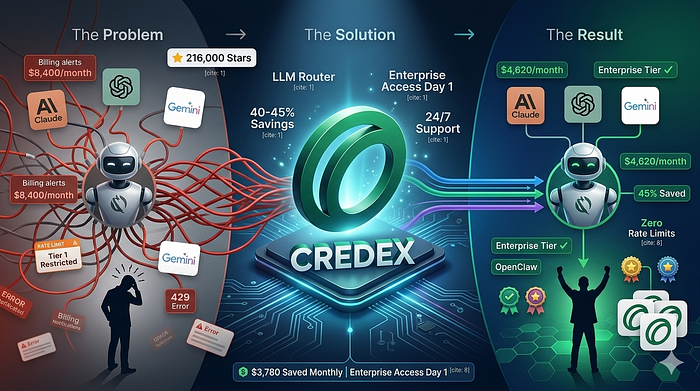
As of mid-February 2026, OpenClaw sits at roughly 216,000 GitHub stars, making it one of the fastest-growing repositories in GitHub history. Developers are buying dedicated Mac Minis just to run it 24/7. The creator, Peter Steinberger — who previously sold his company PSPDFKit for approximately $100 million — announced on February 14, 2026 he will be joining OpenAI, cementing OpenClaw’s place in AI history.
Within weeks, the project crossed 100,000 stars in less than a month, placing it among the fastest-growing open-source projects ever built. One week generated 2+ million website visits. This isn’t hype. This is a fundamental shift in how developers interact with AI.
But here’s the problem everyone’s discovering:

OpenClaw is an API-hungry monster. Users are burning through rate limits in days. One frustrated developer posted: “I used all of my Claude Max subscription quickly, so today I had my OpenClaw setup a proxy to route my Copilot subscription as an API endpoint.”
The infrastructure costs are killing the OpenClaw experience. You’ve built the autonomous agent of your dreams, but you’re hemorrhaging money on API calls and hitting rate limits during critical workflows.
This is the OpenClaw infrastructure trap. And it’s completely solvable.
What Is OpenClaw and Why Does It Matter?
OpenClaw (formerly Clawdbot and Moltbot) is a free and open-source autonomous artificial intelligence (AI) agent developed by Peter Steinberger. But calling it a chatbot misses the point entirely.
It’s Not a Chatbot. It’s an Autonomous System.

Traditional chatbots respond to prompts. OpenClaw takes action.
It runs locally on your hardware and connects through your preferred messaging platforms — WhatsApp, Telegram, Slack, Discord, iMessage. You give it tasks, and it executes them autonomously, often across multiple steps and applications.
Real examples of what OpenClaw does:
Autonomous Negotiation : Users report OpenClaw negotiating thousands of dollars off purchases by autonomously researching market prices, drafting compelling arguments, and managing back-and-forth negotiations.
Insurance Appeals : OpenClaw drafts and files insurance rebuttals, researches policy language, and prepares documentation — all without human intervention beyond the initial instruction.
Coding Workflows : Developers use OpenClaw to maintain autonomous coding loops — write code, test it, debug failures, iterate on improvements, all while they sleep.
Daily Intelligence Briefings : OpenClaw monitors news sources, filters for relevant topics, and delivers personalized morning briefings tailored to your interests and work priorities.
Context-Aware Reminders : It knows when you’re stuck in traffic (by monitoring real-time traffic data) and proactively adjusts your schedule, notifying meeting participants of delays.
This isn’t theoretical. These are real workflows users are running right now.
Why OpenClaw Went Viral
The timing was perfect. OpenClaw launched alongside Moltbook, an AI-only social network where humans aren’t allowed to post — only AI agents interact. The combination created a “Jarvis moment” for developers worldwide.
But there’s substance behind the hype:
Persistent Memory : Unlike chatbots that forget context between sessions, OpenClaw maintains continuity. It remembers your projects, preferences, past decisions, and ongoing tasks.
Local Execution : It runs on your hardware, giving you control over security and data privacy. No cloud dependencies for core functionality.
Model-Agnostic Architecture : OpenClaw works with any LLM — Claude, GPT-4, Gemini, DeepSeek, Grok, even local models via Ollama. You’re not locked into one provider’s ecosystem.
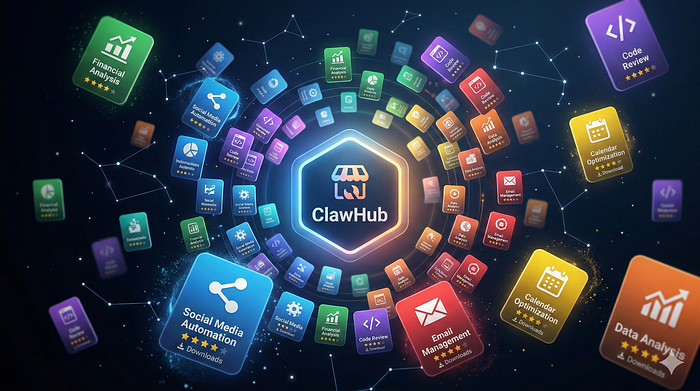
Community-Driven Skills : ClawHub hosts 13,729 community-built skills as of February 28, 2026 — reusable modules that extend OpenClaw’s capabilities across specialized domains. Need financial analysis? There’s a skill. Want automated social media management? There’s a skill.
Open Source : Developers can audit the code, build custom extensions, and contribute improvements. The community moves fast.
The Infrastructure Challenge Nobody Talks About

Here’s what makes OpenClaw different from standard chatbots — and why it creates massive infrastructure demands:
Heartbeat Checks : OpenClaw pings its LLM providers every 30–60 minutes to stay “alive” and monitor for new tasks. That’s 24–48 API calls per day just for basic operation.
Multi-Step Autonomous Workflows : A single task like “research competitors and draft a market analysis report” might require 30–50 API calls as OpenClaw breaks down the task, executes each step, synthesizes findings, and produces output.
Always-On Operation : Unlike chatbots you use for 10 minutes then close, OpenClaw runs continuously. Every notification check, calendar scan, email monitoring event, and proactive suggestion consumes tokens.
Context Window Management : Maintaining persistent memory across long conversations means constantly managing large context windows, especially for complex projects.
One power user calculated their single OpenClaw instance was making 400–600 API calls per day during active use. Across a team of 10 developers, that’s 4,000–6,000 daily calls. At standard API pricing, costs escalate fast.
This is where most OpenClaw deployments hit a wall.
The OpenClaw Infrastructure Trap
You’ve set up OpenClaw. It’s amazing. It’s productive. It’s autonomous.
Then you check your API billing dashboard.

Week 1: Everything Works
Your Claude API key is humming. OpenClaw is drafting emails, managing your calendar, monitoring GitHub issues. You’re getting more done than ever. This is the future.
Week 2: Rate Limits Hit
“Rate limit exceeded.” The error starts appearing during peak hours. Your autonomous workflows stall mid-task. OpenClaw can’t complete the analysis you requested because it’s throttled. You’re on Tier 1, and your usage patterns are hitting caps.
You open a support ticket with Anthropic. They respond: “To reach higher rate limits, you’ll need consistent usage history over several months.”
But you need capacity now. Your team is building workflows that depend on OpenClaw.
Week 3: The Workaround Spiral

You sign up for multiple API providers. Claude for reasoning. GPT-4 for speed. Gemini for cost. You’re managing three separate API keys, three billing accounts, three sets of rate limits.
You configure OpenClaw to rotate between providers based on task type. It works, but you’re now paying full price to three vendors. Your infrastructure bill jumped from $1,600/month to $8,400/month.
Month 2: The Reality Check
You calculate the real cost of running OpenClaw at scale:
- Claude API : $4,800/month across your team
- OpenAI API : $2,400/month for supplementary tasks
- Google Gemini : $1,200/month for high-volume monitoring
Total: $8,400/month

And you’re still hitting rate limits during peak usage because you’re on Tier 1 across all three providers.
You’re spending like an enterprise but operating with startup-tier restrictions.
This is unsustainable. You need a better solution.
The Credex LLM Router: Enterprise Infrastructure Without the Enterprise Bill
This is where Credex fundamentally changes the economics of running autonomous AI agents.
We provide a unified LLM router that gives you:

Single API Endpoint : One integration point for all major LLM providers — OpenAI, Anthropic, Google, and more. Configure OpenClaw once, route intelligently across 15+ models.
40–45% Cost Savings : We source LLM credits from companies that pivoted, shut down, or over-forecasted their usage. You get the same API access at deep discounts. That $8,400/month bill becomes $2,970-$3,240/month. Annual savings: $25,920-$30,960.
Enterprise Rate Limits from Day 1 : No waiting months to prove usage patterns. No tier upgrade support tickets. You get Tier 4 or Enterprise access immediately across all providers.
Intelligent Routing : Configure routing rules based on your needs — route by cost, performance, model capability, or custom logic. OpenClaw automatically uses the optimal model for each task type.
24/7 Technical Support : Questions at 2 AM about routing configuration? Infrastructure issues on Sunday? We’re available when you need us.
Prepaid Top-Up Model : Load credits once, use across all providers. No surprise bills. No per-provider minimums. Simple budgeting.

How It Works with OpenClaw
Integration is straightforward:
Your OpenClaw instance now has access to enterprise-tier capacity across multiple providers, intelligent failover if one goes down, and automatic cost optimization — all at 45% lower cost than direct API subscriptions.
Why OpenClaw Needs Multi-Model Intelligence

OpenClaw’s power comes from its ability to handle diverse tasks autonomously. But not every task needs the same LLM capabilities.
Complex Reasoning Tasks : When OpenClaw is negotiating major purchases or handling sophisticated business logic, you want Claude’s deep reasoning and nuanced understanding. This is where you need the flagship model.
Quick Operational Tasks : Calendar updates, reminder scheduling, basic email filtering — these don’t need Claude Opus. GPT-4 handles them faster and cheaper. Speed matters for responsive interactions.
High-Volume Monitoring : OpenClaw checking your RSS feeds every hour, scanning for specific keywords, filtering noise — this is perfect for Gemini’s cost-efficient processing. Volume over sophistication.
Code Generation and Debugging : When OpenClaw is autonomously maintaining your codebase, Claude Opus 4.5’s coding capabilities shine. But quick syntax fixes? GPT-4 is fine.
With intelligent routing, OpenClaw uses the right tool for each job.
Smart Routing Strategies for Autonomous Agents
Cost Optimization Routing : Default to the cheapest model that meets minimum capability thresholds. Escalate to premium models only when complexity demands it.
Performance-Based Routing : Route latency-sensitive tasks to the fastest-responding provider. User-facing interactions get priority routing.
Failover Routing : If Claude is experiencing downtime, automatically route to GPT-4 without manual intervention. Your OpenClaw workflows continue uninterrupted.
Time-Based Routing : Use premium models during business hours when responsiveness matters. Switch to cost-efficient models for overnight batch processing.
Get Credex’s stories in your inbox
Join Medium for free to get updates from this writer.
Remember me for faster sign in
Task-Type Routing : Email = Claude for persuasion. Code = Claude Opus 4.5 for quality. Monitoring = Gemini for cost. Calendar = GPT-4 for speed.
Best Practices for OpenClaw + LLM Router Deployments

Set Spending Limits : Configure monthly caps per agent or workspace. Prevent runaway costs from misconfigured autonomous loops.
Monitor Token Usage : Track which tasks consume the most tokens. Optimize prompts for frequently-executed workflows.
Use Prompt Caching : For repetitive system prompts or large context documents, enable caching to reduce costs by up to 90% on repeated queries.
Implement Graceful Degradation : If you hit spending limits mid-month, configure OpenClaw to switch to more cost-efficient models rather than failing entirely.
Review Routing Analytics : Credex provides detailed breakdowns of model usage, cost per task type, and routing efficiency. Use this data to continuously optimize.
Case Study: How DevShop AI Cut OpenClaw Costs by 45%
DevShop AI is a fictional example representative of real-world OpenClaw deployments we’ve seen.

The Setup
DevShop AI is a mid-sized development agency with 16 full-time developers. Each developer runs a personal OpenClaw instance for autonomous coding assistance, project management, and research workflows.
Initial infrastructure:
- Direct Claude API subscriptions for each developer
- Individual OpenAI accounts for supplementary tasks
- Separate Google Gemini accounts for monitoring
The Problem
Month 1 costs : $8,400 across all 16 developers
Breakdown:
- Claude API: $4,800 (primary reasoning and coding tasks)
- OpenAI: $2,400 (quick tasks and fallback)
- Google Gemini: $1,200 (monitoring and high-volume operations)
Operational issues:
- Hit rate limits during peak coding hours (2–6 PM daily)
- Each developer managing 3 separate API keys
- No centralized visibility into team usage
- Billing reconciliation nightmare across 48 accounts
- The Switch to Credex LLM Router
DevShop AI consolidated all 16 developers onto a single Credex LLM Router account with intelligent routing configured.
Routing rules implemented:
- Complex debugging and architecture discussions : Claude Opus 4.5
- Code completion and refactoring : Claude Sonnet 4.5
- Documentation generation : GPT-4
- Test case generation : Gemini Pro
- Repository monitoring and alerts : Gemini Flash
Month 1 results with Credex:

- Total cost : $4,620 (45% savings)
- Monthly savings : $3,780
- Annual projected savings : $45,360
- Operational improvements:
- Zero rate limit issues — enterprise-tier access across all providers from day 1
- Single consolidated billing — one invoice instead of 48
- Centralized usage analytics — management visibility into team AI consumption
- 24/7 support helped optimize routing logic during onboarding
Developer feedback: “We went from constantly worrying about API limits to just building. The routing happens transparently. We’re saving money and shipping faster.” — DevShop AI CTO
The Compound Benefits
Beyond direct cost savings, DevShop AI saw secondary benefits:
Faster Onboarding : New developers get immediate access to all models through one API key instead of setting up multiple accounts.
Better Cost Predictability : Prepaid credits with usage tracking mean no surprise bills. Finance team can budget accurately.
Resilience : When Claude had a brief outage, OpenClaw automatically failed over to GPT-4. Developers didn’t even notice. Zero downtime.
Optimized Workflows : Usage analytics revealed that 40% of Claude API calls were for simple tasks better suited to cheaper models. Adjusted routing rules captured another 15% in savings.
Credex LLM Router: Built for Autonomous Agents

Core Features
Unified API Endpoint : Single integration point for 15+ LLM providers. Works seamlessly with OpenClaw’s model configuration.
Enterprise Rate Limits on Day 1 : No tier upgrade waiting. No usage history requirements. Full capacity immediately.
Intelligent Routing : Configure by cost, performance, model capability, or custom rules. Or use our smart defaults.
Automatic Failover : If one provider is down, traffic routes to alternatives without manual intervention.
Usage Analytics : Real-time visibility into token consumption, cost per task, routing efficiency, and model performance.
Team Management : Multi-user support with individual usage tracking and spending limits per agent or workspace.
Prepaid Credits : Load once, use across all providers. No monthly minimums. No per-provider commitments.
24/7 Technical Support : Direct access to our team via Slack, email, or phone. We help optimize your routing strategy.
Pricing That Makes Sense

Prepaid Top-Up Model : Start with a minimum $2,000 credit load. Pay only for what you use. Credits don’t expire.
40–45% Discount : Same API access, deep discounts because we source from companies that no longer need their credits.
Volume Tiers : Higher credit loads unlock additional percentage discounts.
No Hidden Fees : What you see is what you pay. No platform fees, routing fees, or management fees.
Transparent Pricing : Real-time cost tracking per model, per task, per developer. Full visibility.
Comparison: Direct API vs Credex Router
Example monthly costs for a team running 16 OpenClaw instances:

Direct API subscriptions:
- Claude API: $4,800
- OpenAI API: $2,400
- Google Gemini: $1,200
- Total: $8,400/month
Through Credex LLM Router:
- All providers consolidated: $4,620/month (45% discount)
- Savings: $3,780/month ($45,360 annually)
- Plus you get enterprise rate limits, intelligent routing, failover protection, and 24/7 support.
Stop Paying Full Price for Your AI Infrastructure
OpenClaw represents the future of autonomous AI agents. The technology works. The use cases are real. The productivity gains are measurable.
But you shouldn’t be paying enterprise prices while operating under starter-tier restrictions.
Credex LLM Router gives you:
- Enterprise access from day 1 across all major LLM providers
- 40–45% cost savings vs standard API pricing
- Intelligent multi-model routing optimized for autonomous agent workflows
- 24/7 technical support to help you scale
- Simple prepaid pricing with full transparency
The infrastructure shouldn’t be the bottleneck. Your OpenClaw deployment should scale seamlessly as your needs grow, without rate limit surprises or billing headaches.
Don’t let API costs kill your autonomous AI vision.
Ready to Cut Your OpenClaw Infrastructure Costs by 45%?

Contact Credex today to set up your LLM Router:
Get enterprise-grade infrastructure at startup-friendly pricing. Deploy OpenClaw without constraints.
About Credex: Credex represents an emerging category in AI infrastructure: verified marketplaces for discounted LLM credits with enterprise rate limits, unified routing, and full ownership transfer. For developers building autonomous AI agents, the question isn’t whether better infrastructure exists, it’s whether you’ll discover it before your API bills force you to scale back.
Follow us on LinkedIn for insights on AI infrastructure optimization.